Alekhine Defense
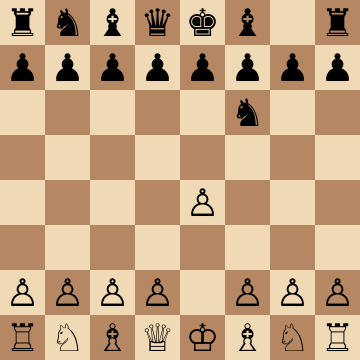
1.e4 Nf6
The Alekhine Defense (1.e4 Nf6) is the ultimate provocation: Black attacks e4 on move one and invites White to chase the knight with pawns. Every pawn White pushes becomes a long-term target — Black strikes back at the overextended center with ...d6, ...c5 and piece pressure, turning White's early space into weakness.
Mainline
1.e4 Nf6 2.e5 Nd5 3.d4 d6 4.Nf3 g6 5.Bc4 Nb6 6.Bb3 Bg7
Four Pawns Attack (4.c4 and 5.f4)
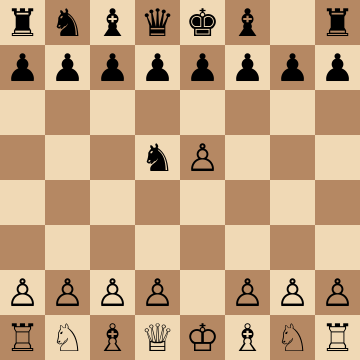
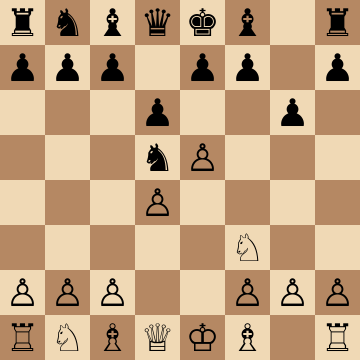
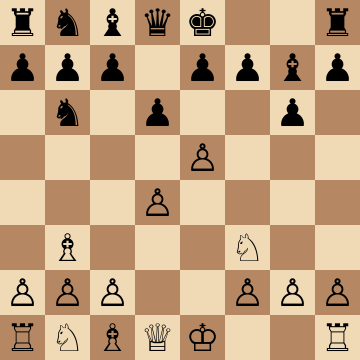
1.e4 Nf6 2.e5 Nd5 3.d4 d6 4.c4 Nb6 5.f4 dxe5 6.fxe5 Nc6 7.Be3 Bf5 8.Nc3 e6 9.Nf3 Be7
White's maximalist reply — four pawns abreast by move five — is exactly what the Alekhine invites. Black develops calmly with 6...Nc6 and 7...Bf5, piles pressure on d4, and prepares ...f6 or ...Qd7 with long castling. Every tempo White spent pushing pawns was not spent on pieces, so one inaccuracy and the big center becomes a row of targets. Learn the setup cold and you will welcome this line with Black.
Study the Alekhine: Four Pawns Attack course
Modern Variation with 4...Bg4
1.e4 Nf6 2.e5 Nd5 3.d4 d6 4.Nf3 Bg4 5.Be2 e6 6.O-O Be7 7.c4 Nb6 8.Nc3 O-O
The classical treatment of the Modern: Black pins the f3 knight, quietly finishes development, and only then decides where to strike. The standard plan is ...d5 or ...dxe5 followed by ...N8d7 and ...c5, chipping at White's center from a safe structure. This is the Alekhine at its most solid — no early fireworks, just healthy pieces and a center that must constantly justify itself.
Exchange Variation (5.exd6 cxd6)
1.e4 Nf6 2.e5 Nd5 3.d4 d6 4.c4 Nb6 5.exd6 cxd6 6.Nc3 g6 7.Be3 Bg7 8.Rc1 O-O 9.b3 e5
Recapturing with the c-pawn gives Black a half-open c-file and a compact, flexible structure. Against the well-known Voronezh setup (Be3, Rc1, b3), the key resource is the timely ...e5 break shown here — if White ever takes on e5, Black's pieces flood the center. Play for ...Nc6, ...Bg4 or ...Bf5, and pressure down the c-file; Black's position is easier to handle than White's.
Chase Variation (3.c4 Nb6 4.c5)
1.e4 Nf6 2.e5 Nd5 3.c4 Nb6 4.c5 Nd5 5.Bc4 e6 6.Nc3 Nxc3 7.dxc3 b6
Chasing the knight a third time looks scary but overextends White on both wings. After 6...Nxc3 7.dxc3, the thematic strike 7...b6 hits the c5 pawn at once: exchanges on b6 open the a-file for Black's rook, while defending c5 ties White's pieces to a weakness. Black follows with ...Nc6, ...d6 and easy development — a model example of the Alekhine's core lesson that pawn advances leave holes behind them.
Two Knights Sideline (2.Nc3)
1.e4 Nf6 2.Nc3 d5 3.exd5 Nxd5 4.Bc4 Nb6 5.Bb3 Nc6
Many club players sidestep the main lines with 2.Nc3, but 2...d5 immediately equalizes the fight for the center. After the exchange on d5, Black gains time on the c4 bishop with ...Nb6 and develops smoothly with ...Nc6, ...e5 or ...g6 next. There is nothing here for White beyond a quiet game — and since Black's setup builds itself, you can play this position confidently on move-one knowledge.
Key ideas
- Provoke e5, d4, c4 and even f4 — then attack the pawn chain White must now defend.
- Undermine with ...d6 and ...c5 at the right moment, opening lines while White's pieces are still at home.
- Develop the fianchetto setup with ...g6 and ...Bg7 for lasting pressure against d4 and e5.
- Play positions your opponent has rarely studied — most 1.e4 players see the Alekhine a few times a year.
Typical plans and structures
After the main sequence 1.e4 Nf6 2.e5 Nd5 3.d4 d6, Black exchanges on e5 or maintains the tension, then targets the advanced pawns with ...Bg4 or ...Bf5, ...Nc6 and a timely ...c5. If White grabs maximum space with the Four Pawns Attack, Black's counterblows hit an overstretched structure. Endgames are often excellent for Black, whose compact position has no weaknesses while White's advanced pawns need constant care.
How to reach the Alekhine Defense
The Alekhine is 1.e4 Nf6, provoking 2.e5 Nd5. After 3.d4 d6 White's fourth move defines the variation: 4.Nf3 is the Modern, met by 4...Bg4, 4...g6 or 4...dxe5; 4.c4 Nb6 5.f4 is the Four Pawns Attack; 4.c4 Nb6 5.exd6 is the Exchange Variation, with ...exd6 or ...cxd6 for Black; and 3.c4 Nb6 4.c5 is the Chase Variation. White can also decline with 2.Nc3, when 2...d5 or 2...e5 lead to Vienna or Scandinavian-type positions, or 2.d3.
Pros and cons of the Alekhine Defense
Pros
- Provokes White into overextending: every pawn push gains space but creates targets for ...d6, ...c5 and piece pressure.
- Unusual and under-studied at club level, so opponents often play the first moves badly.
- Hypermodern and strategically rich; it teaches how to attack a pawn center rather than fear it.
- Sound: engines and grandmaster practice confirm Black has full play in every main line.
Cons
- White gets a big center and a space advantage for free, and against the calm Modern Variation Black's position can be cramped.
- The knight makes several moves early and can end up offside on b6.
- The Four Pawns Attack leads to very sharp positions that must be known precisely.
- White can decline with 2.Nc3 or 2.d3 and take away most of the opening's character.
How to play against the Alekhine Defense
White's best is to take the space on offer but not more than can be held: the Modern Variation 2.e5 Nd5 3.d4 d6 4.Nf3 develops, keeps the center with c4 later, and asks Black to prove the pressure is real; against 4...Bg4 play Be2 and O-O, against 4...g6 the setup with c4, Nb6, Be2 and Nc3. The Exchange Variation 4.c4 Nb6 5.exd6 is the safe route to a small, lasting edge from the space and the c-file. The Four Pawns Attack 5.f4 is the most ambitious and the most double-edged; play it only with preparation. Declining with 2.Nc3 is playable but throws away the reason the Alekhine is provocative. In every line, do not overextend: pawns on c4, d4, e5 and f4 are only strong if they can be defended, and Black's whole plan is to attack them.
Plans for both sides
White's plan
Take space with e5, d4 and c4, defend the center with pieces, and use the extra room for a kingside attack or a queenside expansion with c5 and b4. Kick the knight when it is useful, not by reflex, and exchange on d6 when Black's counterplay against e5 becomes real.
Black's plan
Undermine the center with ...d6, ...c5 and ...e6 or ...g6 and ...Bg7, develop the light-squared bishop to g4 or f5 before ...e6, and attack the overextended pawns with pieces. Use the knight on b6 for ...Nc6 and ...Nd7 regroupings, and welcome the exchange on d6 that leaves White's center static.
Who should play it
Counterattacking players who enjoy strategic imbalance, are comfortable conceding space, and want a defense to 1.e4 their opponents barely know.
History of the Alekhine Defense
The defense was introduced by the future world champion Alexander Alekhine in 1921, when he used it against Endre Steiner at Budapest, and it was one of the first hypermodern defenses to be taken seriously. It was never a mainstream choice but had famous adherents: Fischer played it twice in his 1972 world championship match against Spassky, and Korchnoi, Bagirov and later Shabalov and Baburin kept it alive. Carlsen has used it as a surprise weapon in rapid play, and it remains the choice of players who like to provoke.
Frequently asked questions
Is the Alekhine Defense sound?
Yes. It has been played by world champions — including Alexander Alekhine, who introduced it at top level in 1921, and modern elite players as a surprise weapon. White gets chances for an edge with precise play, but nothing close to a refutation exists.
What is the main idea of the Alekhine Defense?
Black deliberately lets White build a big pawn center, betting that it will become overextended. The knight hops (Nf6-d5-b6) lure the pawns forward, and then ...d6 and ...c5 strike back at a center that is more weakness than strength.
How do I handle the Four Pawns Attack as Black?
The Four Pawns Attack (4.c4 Nb6 5.f4) is White's most ambitious try and the critical test. Black counters in the center with ...dxe5 and ...Nc6 or ...c5, exploiting the weaknesses behind White's pawn wall — this course covers a full plan against it.
Is the Alekhine Defense good for beginners?
It is playable but demanding: beginners tend to fear White's pawn center rather than attack it, and the knight's early moves can look aimless without a plan. It suits improving players who already understand pawn structures and want an unusual, provocative weapon.
How do you play against the Alekhine Defense?
Take the space with 2.e5 and 3.d4 but hold it with pieces: the Modern Variation 4.Nf3 and the Exchange Variation 4.c4 Nb6 5.exd6 both give a comfortable edge without overextending. The Four Pawns Attack is the ambitious try, only with preparation.
Did Fischer play the Alekhine Defense?
Yes. Fischer used it twice against Spassky in the 1972 world championship match, in games 13 and 19, winning the first and drawing the second, which did more for the opening's reputation than anything since Alekhine himself.
Learn the Alekhine Defense with AI feedback
This page pairs the guide above with an interactive ChessMind AI course: a GM-authored repertoire you study move by move on a real board, then practice against a human-like chess AI opponent with instant feedback and spaced-repetition review, so the key positions actually stick. Start learning, jump straight into practice, or browse all opening courses.
New to a concept? Every term is defined in the chess terms glossary.